CRUDE OIL
September 14, 2026
Risk Disclaimer: The example below is for illustrative purposes only and is based on price movements derived from Contracts for Difference (CFDs). The calculations reflect hypothetical outcomes using historical or specified price data for the relevant instrument on the stated date and are not indicative of future performance. Any reliance placed on this material is strictly at the user’s own risk.
Weekly Special Report: CRUDE OIL
GEOPOLITICS: YEMEN’S HOUTHIS – SAUDI ARABIA CONFLICT
- BREAKING (SEPTEMBER 12 - 14): 4% OF GLOBAL OIL SUPPLY COULD DISAPPEAR AS THE HOUTHIS ATTACK THE SAUDI EAST-WEST PIPELINE. Saudi Arabia’s major pipeline to the Red Sea was damaged, threatening around 4 million barrels per day, equivalent to roughly 4% of global oil supply. Repairs could take as long as five to six weeks, although partial operations could resume sooner.
- BREAKING (SEPTEMBER 12 - 14): THE BAB EL-MANDEB STRAIT OIL FLOWS AT RISK AS THE HOUTHIS CAPTURE AN IMPORTANT ISLAND. Houthi forces have advanced along Yemen’s Red Sea coast, capturing Mocha and the strategic island of Perim, located in the heart of the Bab el-Mandeb Strait. The route carried around 7–9 million barrels of oil per day before the conflict and has become increasingly important for Saudi oil exports as the Strait of Hormuz remains disrupted.
- SAUDI ARABIA’S OIL PRODUCTION AT THE LOWEST LEVEL SINCE 1990. Saudi Arabia’s oil production fell to 6.24 million barrels per day in August, the lowest level since 1990. At the time, Saudi Arabia used to produce more than 10 million barrels a day of oil.
Sources: Reuters, CNBC
HORMUZ STRAIT:
- THE STRAIT OF HORMUZ REMAINS HEAVILY RESTRICTED, WITH VERY LITTLE OIL TRANSITING THROUGH IT. Iran continues to restrict shipping through the Strait of Hormuz. Around 20 million barrels of oil per day, representing over 20% of global oil demand, normally pass through the Strait of Hormuz, which is now heavily restricted.
- U.S. NAVY BLOCKADE BLOCKS IRANIAN OIL EXPORT. At the same time, the U.S. naval blockade has remained in place since July 14, restricting Iran’s ability to export crude oil and other strategic goods.
Sources: Reuters, CNBC, Bloomberg, OILPRICE.COM
GLOBAL OIL MARKETS:
- POTENTIAL IMPACT: UP TO 30% OF TOTAL GLOBAL OIL DEMAND AT RISK. Total potential disruption could reach up to 28 million barrels per day, equivalent to nearly 30% of total global oil demand. If both the Strait of Hormuz and the Bab el-Mandeb Strait were completely shut down, the impact on global oil supply would be extremely significant, as two of the world’s most important energy chokepoints would be blocked simultaneously.
Sources: Reuters, CNBC, Bloomberg, OILPRICE.COM, Financial Times, International Energy Agency
TECHNICAL ANALYSIS AND PRICE ACTION
- SUPPORT AREA: $95–$90. The $95–$90 area has acted as a key strong support zone since the war started, with crude oil repeatedly holding above or rebounding from this range. Holding above this area could support further upside. However, prices could also decline.
- BREAKING: CRUDE OIL PRICE HIT ITS HIGHEST RATE IN ALMOST 4 MONTHS ($104.425). Crude oil was last trading around $98, and if a full recovery to the March high of $119.40 follows, the price could see an upside of around 22%. However, the price could decline as well.
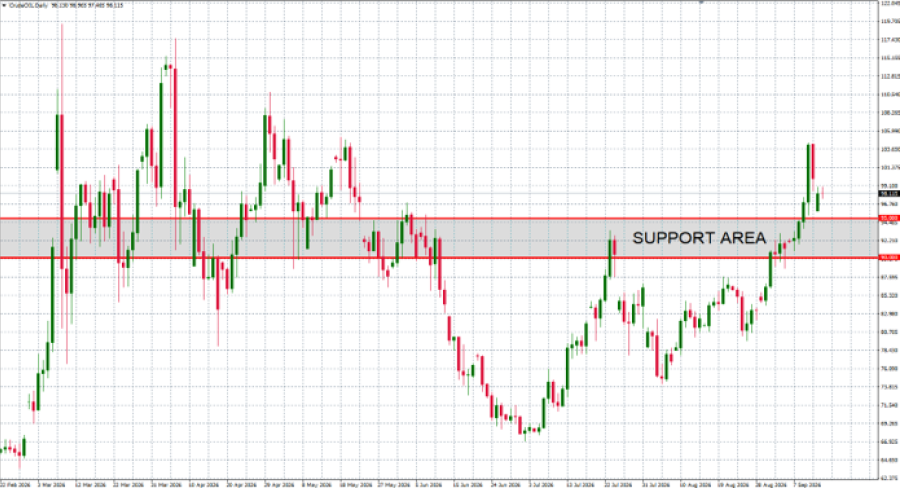
GRAPH (Daily): February 2026 – September 2026
Please note that past performance does not guarantee future results
Crude Oil, September 14, 2026
Current Price: 98
|
Crude Oil |
Weekly |
|
Market Trend |
|
|
110.00 |
|
|
107.00 |
|
|
103.00 |
|
|
93.50 |
|
|
92.00 |
|
|
90.00 |
Example of calculation based on weekly market trend for 1.00 Lot1
|
CRUDE OIL |
||||||
|
Pivot Points |
||||||
|
Profit or loss in $ |
12,000 |
9,000 |
5,000 |
-4,500 |
-6,000 |
-8,000 |
|
Profit or loss in €2 |
10,400 |
7,800 |
4,333 |
-3,900 |
-5,200 |
-6,933 |
|
Profit or loss in £2 |
8,900 |
6,675 |
3,708 |
-3,338 |
-4,450 |
-5,933 |
|
Profit or loss in C$2 |
16,673 |
12,505 |
6,947 |
-6,252 |
-8,336 |
-11,115 |
- The above calculations are made based on 1.00 lot which is equivalent of 1000 units
- Calculations for exchange rate used as of 09:20 (GMT+1) 14/09/2026
You can use risk management tools such as Stop-Loss and Take-Profit.


