Wheat Weekly Special Report based on 1.00 Lot Calculation:
GLOBAL WHEAT MARKET SHARE:
- LARGEST WHEAT PRODUCERS (OF TOTAL PRODUCTION 2025: 793.24 MILLION TONES): China at 17%, India at 14%, Russia at 10%, USA at 6%, and Ukraine at 3%.
- LARGEST WHEAT EXPORTERS OF A TOTAL 212.31 MILLION TONS (2024/2025): Russia at around 20%, the European Union at 14.13%, Canada at 12.25%, Australia at 11.78%, the USA at 10.58%, and Ukraine at 7.54%.
- RUSSIA + UKRAINE SHARE AT NEAR 30% OF TOTAL GLOBAL EXPORTS: Russia and Ukraine account for nearly one-third of total global exports.
MIDDLE EAST WAR ESCALATES:
- TOTAL REGIONAL ESCALATION: The conflict has transitioned into a direct, high-intensity war between the U.S.-led coalition and Iranian forces, characterized by sustained aerial bombardments of Tehran and synchronized missile exchanges across the Persian Gulf.
- REGIONAL CONTAGION AND ECONOMIC SHOCK: Hostilities have expanded into a multi-front regional engagement, and precision strikes on energy infrastructure across Saudi Arabia, the UAE, Qatar, Kuwait, and Bahrain. This instability along with the blockade of the Strait of Hormuz, has severely compromised global energy security and driven oil prices to historic highs.
IMPACT OF WAR ON WHEAT:
- FERTILIZER SUPPLY SHOCK: The Middle East is a critical hub for nitrogen and phosphorus fertilizers, with 25–30% of global nitrogen exports passing through the now-blocked Strait of Hormuz, causing severe supply disruptions for major agricultural producers China, India, and Brazil.
- LOGISTICAL AND FREIGHT COSTS: Transit delays and higher insurance premiums for vessels avoiding the Persian Gulf and Red Sea have increased fuel use by up to 40%. These costs are being passed directly to consumers through higher landed prices for grain.
- CRITICAL WHEAT PRICE SURGE: Fueled by the Middle East escalation, wheat futures have climbed 17.5% over the past month to approximately, driven by a "war premium" as shipping risks spike.
- CRITICAL GLOBAL DEFICIT: Persistent trade blockades and a 29% drop in Russian exports have created a structural supply gap.
GEOPOLITICS: RUSSIA-UKRAINE WAR PERSISTS WITHOUT RESOLUTION
- DIPLOMATIC DEADLOCK AMID REGIONAL TURMOIL: U.S.-brokered peace negotiations have been postponed indefinitely as the escalating conflict in the Middle East diverts international diplomatic resources and forces the cancellation of key trilateral meetings in Abu Dhabi and Geneva.
- THREAT TO BLACK SEA GRAIN HUB: The lack of a resolution keeps high-risk premiums as Russia continues drone and missile strikes on Ukrainian port infrastructure.
- CRITICAL EXPORT CONTRACTION: Systemic supply instability remains high as Russian wheat exports for the current season are forecast to drop to 43 million tons, a significant decline that, combined with Ukraine's limited export capacity, continues to tighten global availability and support elevated wheat prices.
TECHNICAL ANALYSIS:
- UPTREND SINCE JANUARY 2026: Since January 2026, Wheat prices have entered a strong upward trend, consistently forming higher highs. This momentum continues to push prices higher, indicating sustained upward pressure in the market. However, the price could also decline.
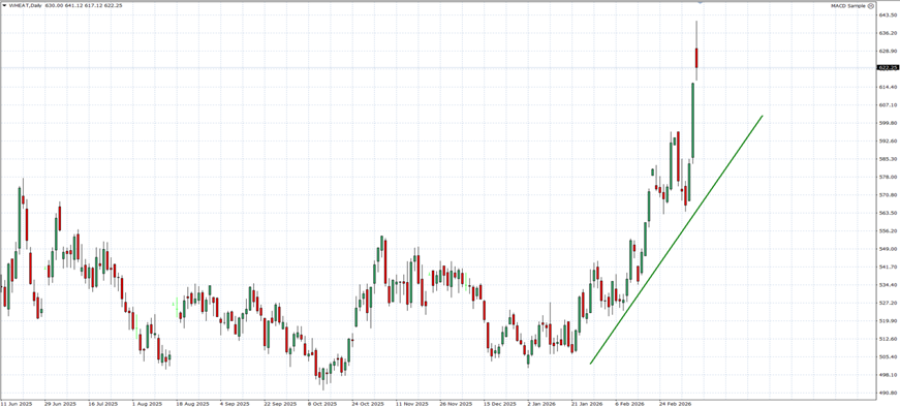
GRAPH (Daily): June 2025 – March 2025
Please note that past performance does not guarantee future results.
WHEAT, March 9, 2026
Current Price: 620
|
Wheat |
Weekly |
|
Trend direction |
|
|
760 |
|
|
720 |
|
|
680 |
|
|
570 |
|
|
560 |
|
|
550 |
Example of calculation based on weekly trend direction for 1.00 Lot1
|
WHEAT |
||||||
|
Pivot Points |
||||||
|
Profit or loss in $ |
14,000 |
10,000 |
6,000 |
-5,000 |
-6,000 |
-7,000 |
|
Profit or loss in €2 |
12,119 |
8,657 |
5,194 |
-4,328 |
-5,194 |
-6,060 |
|
Profit or loss in £2 |
10,487 |
7,491 |
4,494 |
-3,745 |
-4,494 |
-5,243 |
|
Profit or loss in C$2 |
18,950 |
13,536 |
8,122 |
-6,768 |
-8,122 |
-9,475 |
- 1.00 lot is equivalent of 100 units
- Calculations for exchange rate used as of 9:50 (GMT) 09/03/2026
There is a possibility to use Stop-Loss and Take-Profit.
- You may wish to consider closing your position in profit, even if it is lower than suggested one.
- Trailing stop technique could protect the profit.