COCOA (#COCOA)
August 28, 2026
Risk Disclaimer: The example below is for illustrative purposes only and is based on price movements derived from Contracts for Difference (CFDs). The calculations reflect hypothetical outcomes using historical or specified price data for the relevant instrument on the stated date and are not indicative of future performance. Any reliance placed on this material is strictly at the user’s own risk.
Weekly Special Report: COCOA (#COCOA)
FUNDAMENTALS:
- SUPPLY SIDE: Cocoa beans are grown primarily in West Africa, with the Ivory Coast (40% of the world’s total) and Ghana (18% of the world’s total). Behind them are Indonesia (11.4%), Ecuador (6,7%), and Brazil (5.2%).
- DEMAND SIDE: Demand for cocoa is strong and growing, especially from countries that are developing fast, like China and India, with a growing middle class eager to consume and gift chocolate. The demand for cocoa is as follows: Europe (35% of the world’s total), Asia and Oceania (21%), Africa (22%), and the Americas (North and South) (18%).
EVENTS:
- EVENT (LATE AUGUST 2026): INTERNATIONAL COCOA ORGANIZATION (ICCO) QUARTERLY REPORT. The report includes data and analysis on global cocoa production, grindings, stocks, prices, and international trade. For August 2026, it is particularly relevant because the report could provide updated information on the cocoa market and the production outlook at the start of the new 2026/27 cocoa season.
- EVENT (SEPTEMBER 2–3, 2026): COCOA ASSOCIATION OF ASIA INTERNATIONAL COCOA CONFERENCE. The major cocoa industry conference takes place at Marina Bay Sands in Singapore, bringing together industry participants to discuss global cocoa trends, supply, demand and the outlook for the 2026/27 season.
Source: Barchart.com
NEWS:
- IVORY COAST SUPPLY OUTLOOK REDUCED: Early assessments for Ivory Coast's upcoming season project a harvest of 1.8 million metric tons, down 18% from the previous season due to weak cherelle formation. A weak cherelle formation means that fewer young cocoa pods (the fruits of the cocoa tree) are growing on the trees. This is bad for cocoa because it could mean a smaller harvest and lower cocoa supply in the future.
- SUPPLY CONCERS: Ghana's Cocoa Board projected a 2026/27 crop size of 650,000 metric tons, down 13% from the prior year, driven by poor pod counts and disease spread from a lack of sunshine.
- BREAKING (AUGUST 25, 2026): EL NIÑO THREAT INTENSIFIES. Global ocean temperatures hit a record high as El Niño intensifies. El Niño is expected to strengthen through the coming months and potentially reach levels not seen for decades.
TECHNICAL ANALYSIS AND PRICE ACTION
- SUPPORT AREA: $6,000 - $5,500. Cocoa prices have previously established strong technical support area between $6,000 and $5,500.
- UPTREND: COCOA PRICES HIT THE HIGHEST LEVEL IN MORE THAN 9 MONTHS ($6,557). The daily chart below shows that cocoa has been trading within a steady upward trend, rising by around 68% between early June and late August and reaching its highest level in more than nine months at $6,557.
- ALL-TIME HIGH (DECEMBER 18, 2024): $12,911. Cocoa last traded around $6,490 and if the cocoa price tries to recover to its all-time high of $12,911, it can then offer an upside of around 99%. Although prices can fall, too.
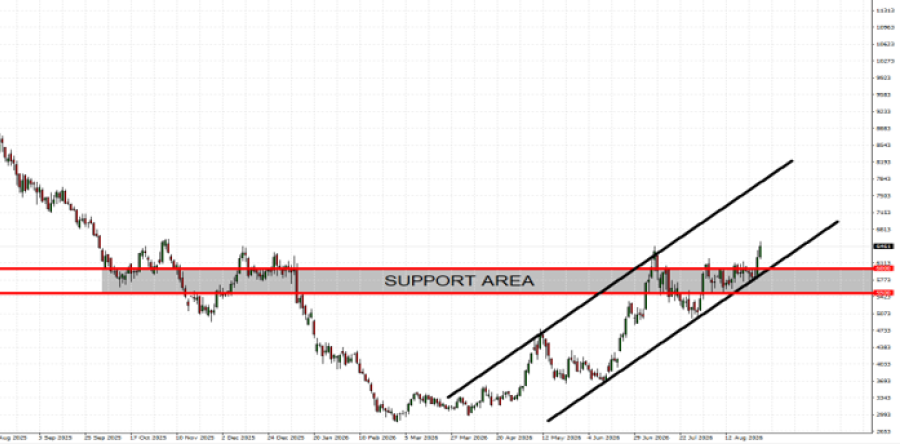
GRAPH (Daily): August 2025 - August 2026
Please note that past performance does not guarantee future results
#COCOA, August 28, 2026
Current Price: 6,490
|
Cocoa |
Weekly |
|
Market Trend |
|
|
8,000 |
|
|
7,500 |
|
|
7,000 |
|
|
6,000 |
|
|
5,700 |
|
|
5,500 |
Example of calculation based on weekly market trend for 1.00 Lot1
|
COCOA |
||||||
|
Pivot Points |
||||||
|
Profit or loss in $ |
15,100 |
10,100 |
5,100 |
-4,900 |
-7,900 |
-9,900 |
|
Profit or loss in €2 |
12,973 |
8,677 |
4,382 |
-4,210 |
-6,787 |
-8,506 |
|
Profit or loss in £2 |
11,122 |
7,440 |
3,757 |
-3,609 |
-5,819 |
-7,292 |
|
Profit or loss in C$2 |
20,926 |
13,997 |
7,068 |
-6,790 |
-10,948 |
-13,719 |
- The above calculations are made based on 1.00 lot which is equivalent of 10 units
- Calculations for exchange rate used as of 13:45 (GMT+1) 28/08/2026
You can use risk management tools such as Stop-Loss and Take-Profit.


